 Lumesson
Complaint handling training template
A 20-minute customer service course on the HEARD method — hear, empathize, apologise, resolve, diagnose — for complaints in person, on the phone or in chat. Learners answer an angry customer, beat the clock, follow a branching case and reflect on their own last complaint, then take a quiz. Play it below, then make it yours.
- 20 minto complete
- 17slides in 4 parts
- 3questions, 2 kinds
- SCORMxAPI · cmi5 · HTML5
Already have Lumesson? Open this template in the app
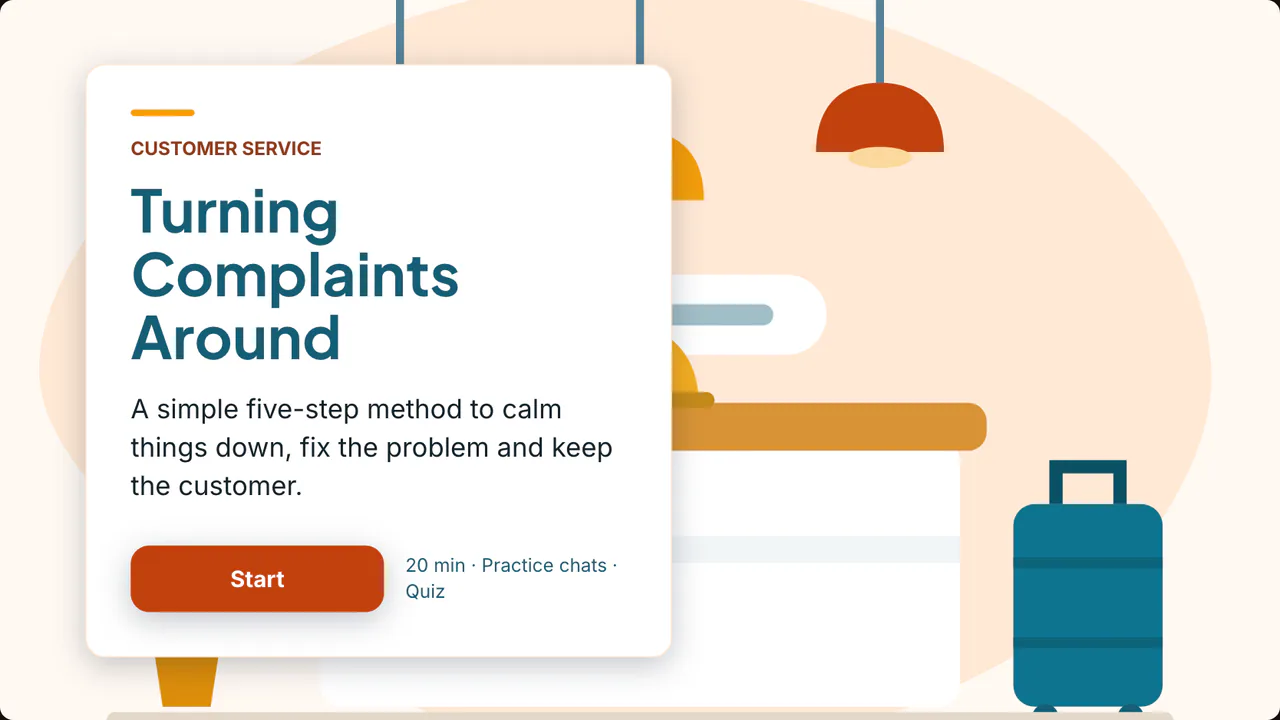 Play the course
Take “Turning Complaints Around” as a learner
This is the real course, published from Lumesson as HTML5. Click through it, try every activity and take the test — nothing you do is recorded.
Open full screenWorks on phones and tablets too
17 slides in 4 parts
A free complaint handling course built on the HEARD method: words that help, a live chat to answer, a timed game, a branching scenario and a quiz. Play it now.
Introduction
2 slidesThe HEARD method
3 slidesPractise
7 slidesQuiz
5 slidesA look at the course
Learning by doing, not by reading
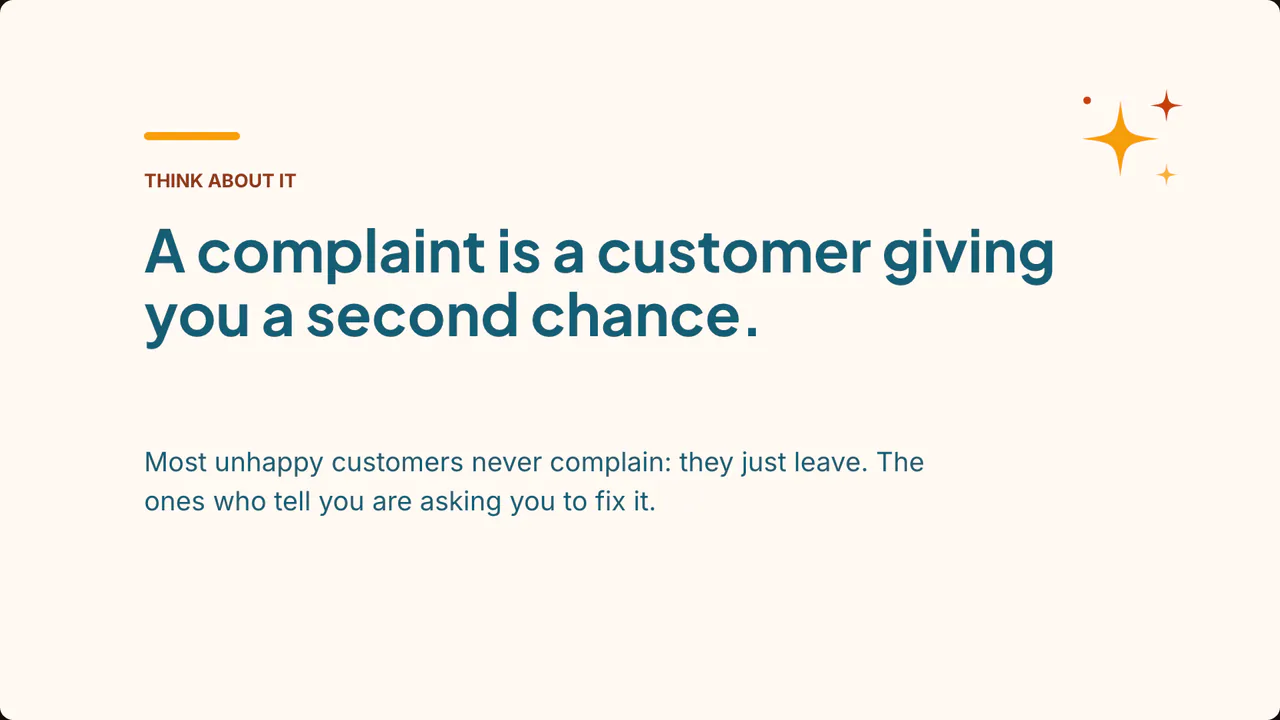
A second chance
One statement to start: a complaint is a customer giving you a second chance — most unhappy customers just leave.
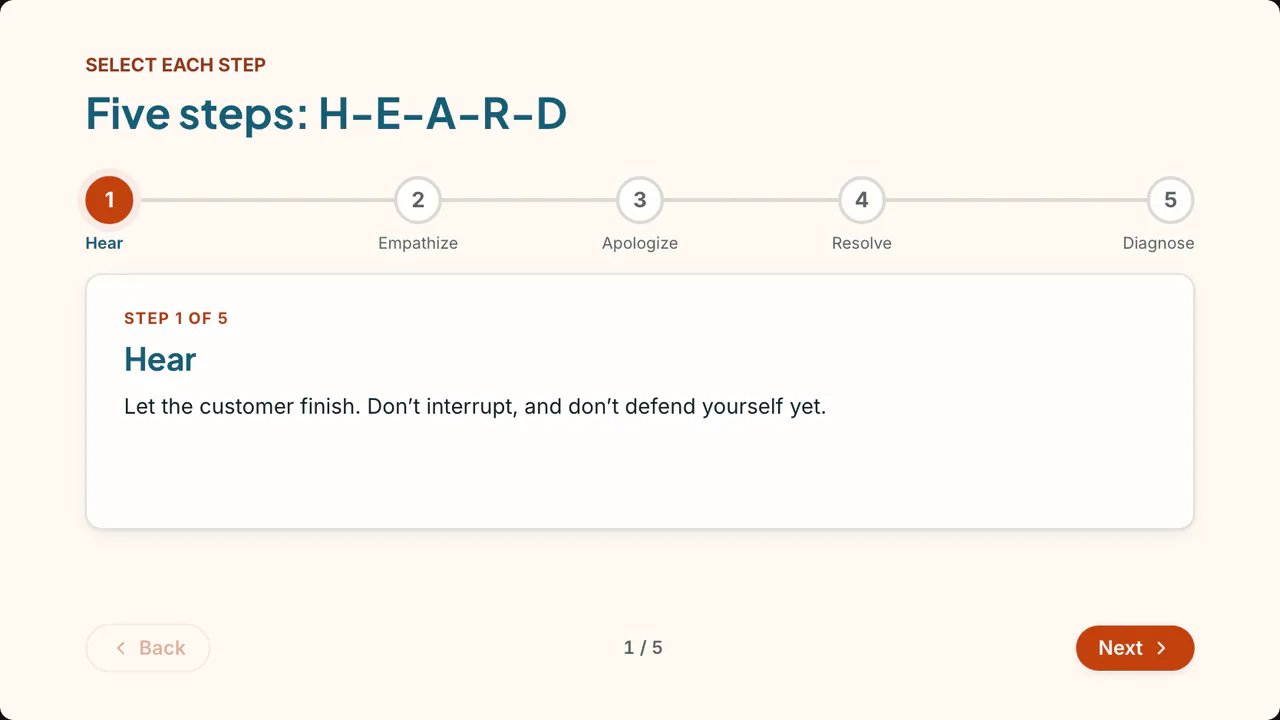
HEARD, step by step
Five steps, one at a time: Hear, Empathize, Apologize, Resolve and Diagnose, each with what to do.
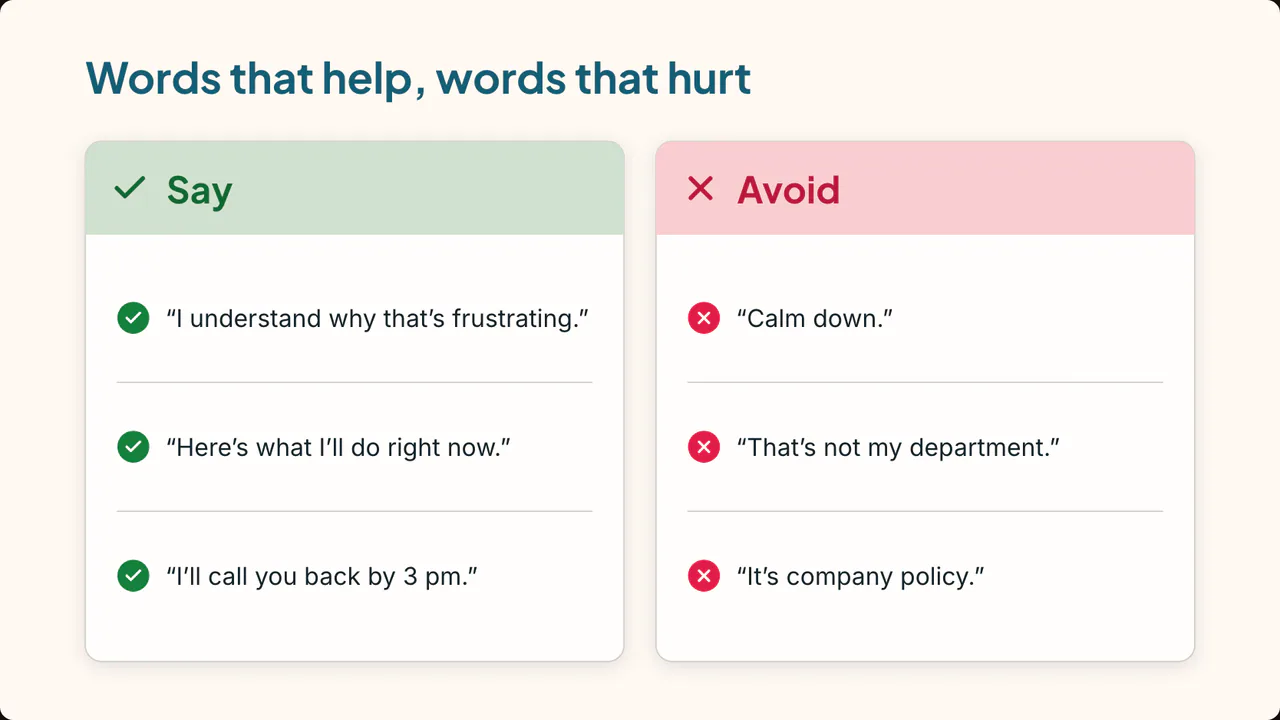
Words that help, words that hurt
Three things to say and three to avoid, side by side — “Here’s what I’ll do right now”, never “Calm down”.
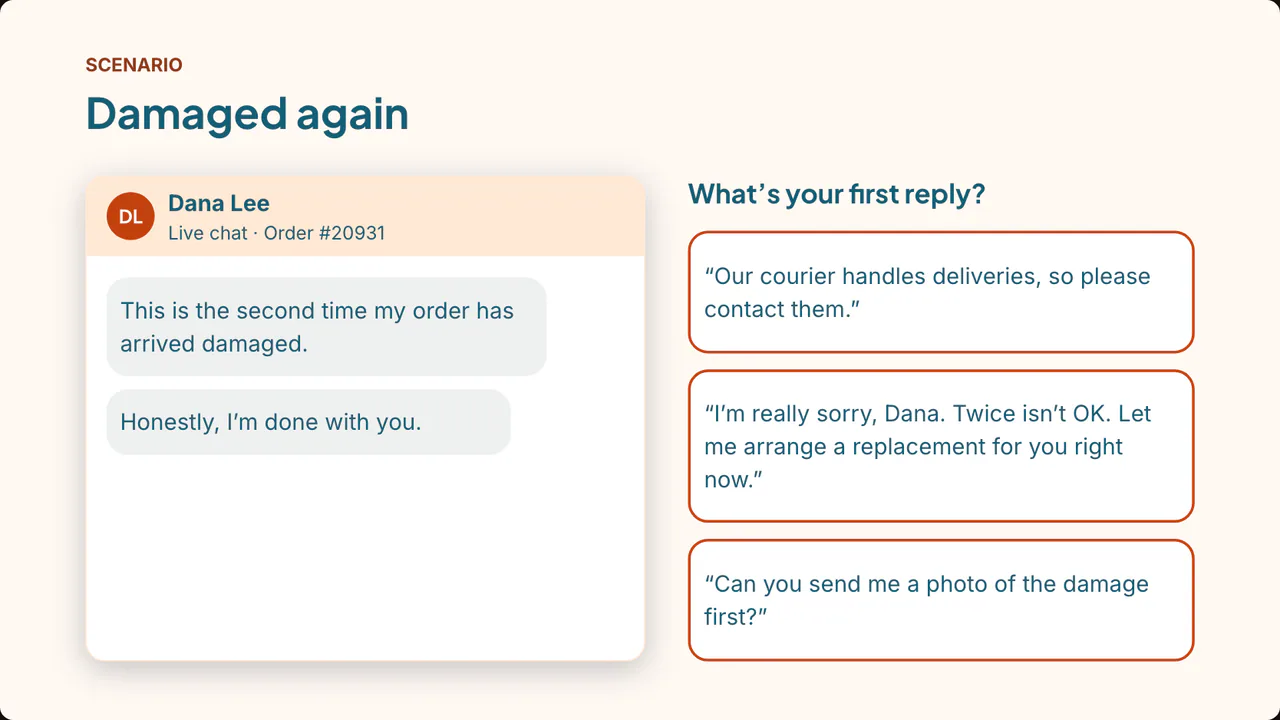
Damaged again
A live chat with a customer whose order arrived damaged for the second time. Learners pick the first reply and see why it works or not.
Helps or hurts? Beat the clock
A timed quick-fire game: four phrases, sorted into helps or hurts before the time runs out.
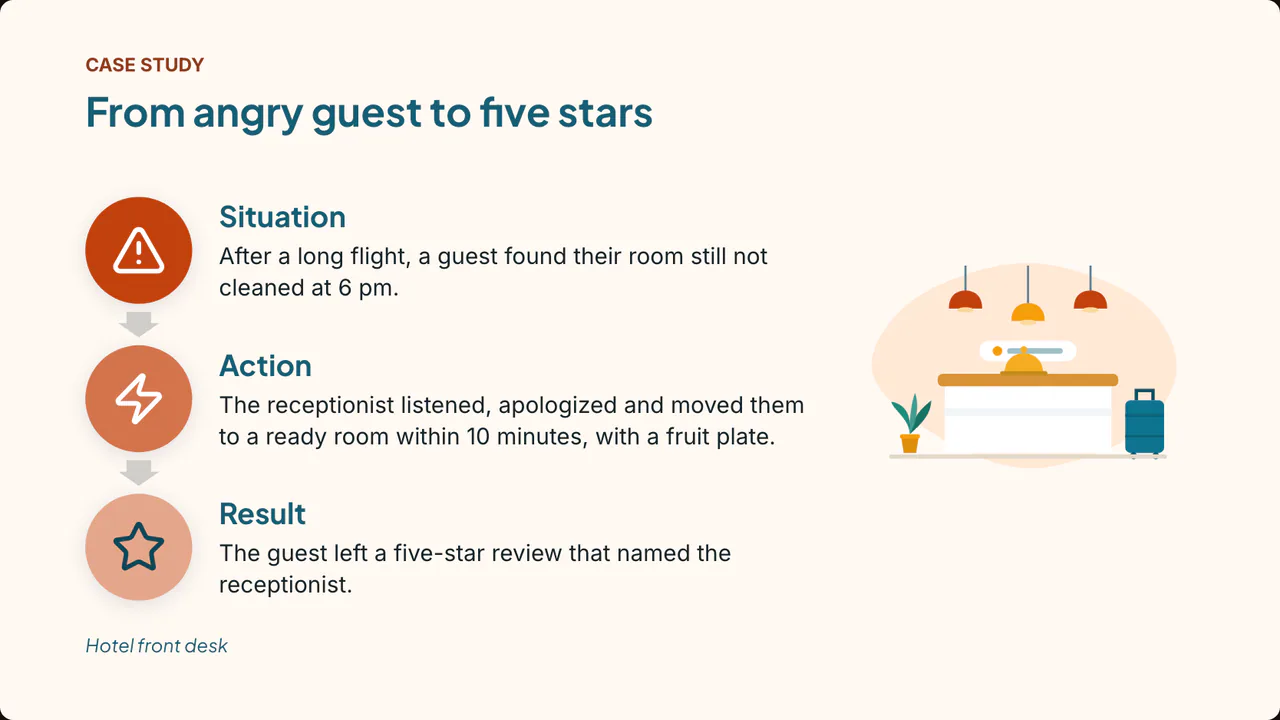
From angry guest to five stars
A real-life case at a hotel front desk: the situation, what the receptionist did and the result.
A branching scenario
A long-time customer wants to cancel. Two decisions lead to one of three outcomes — from relationship saved to customer lost — and learners can try another path.
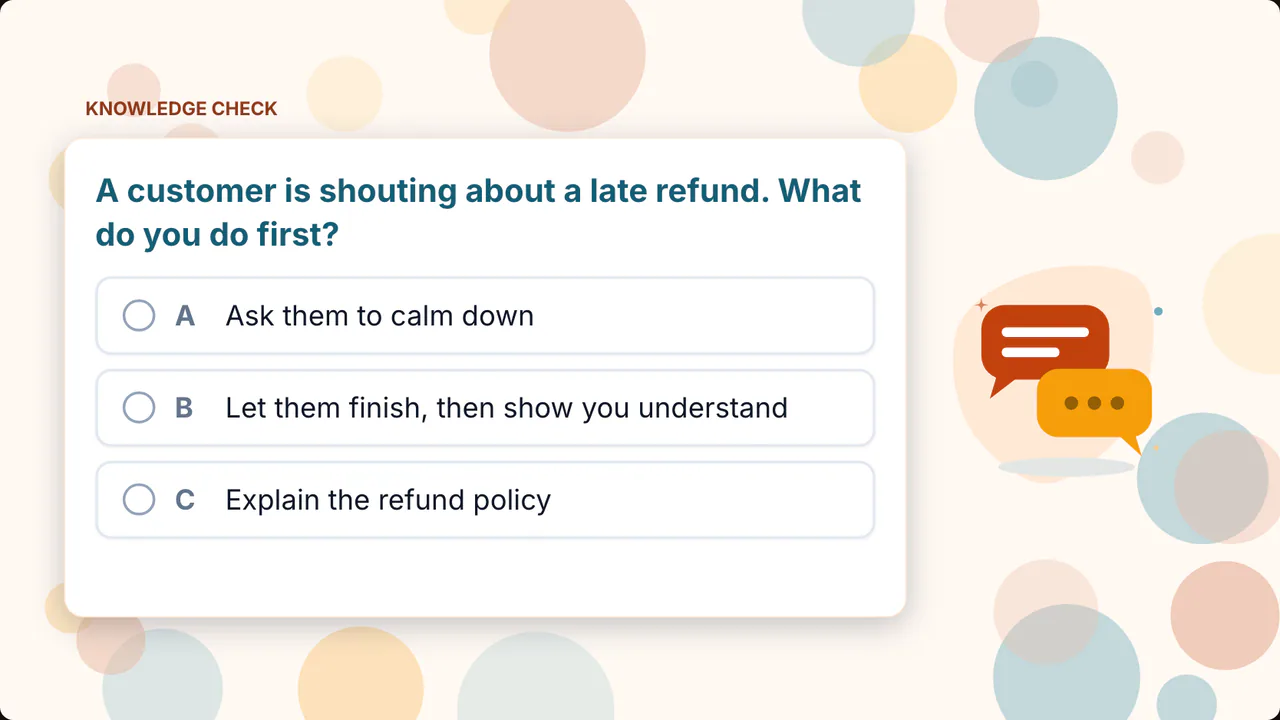
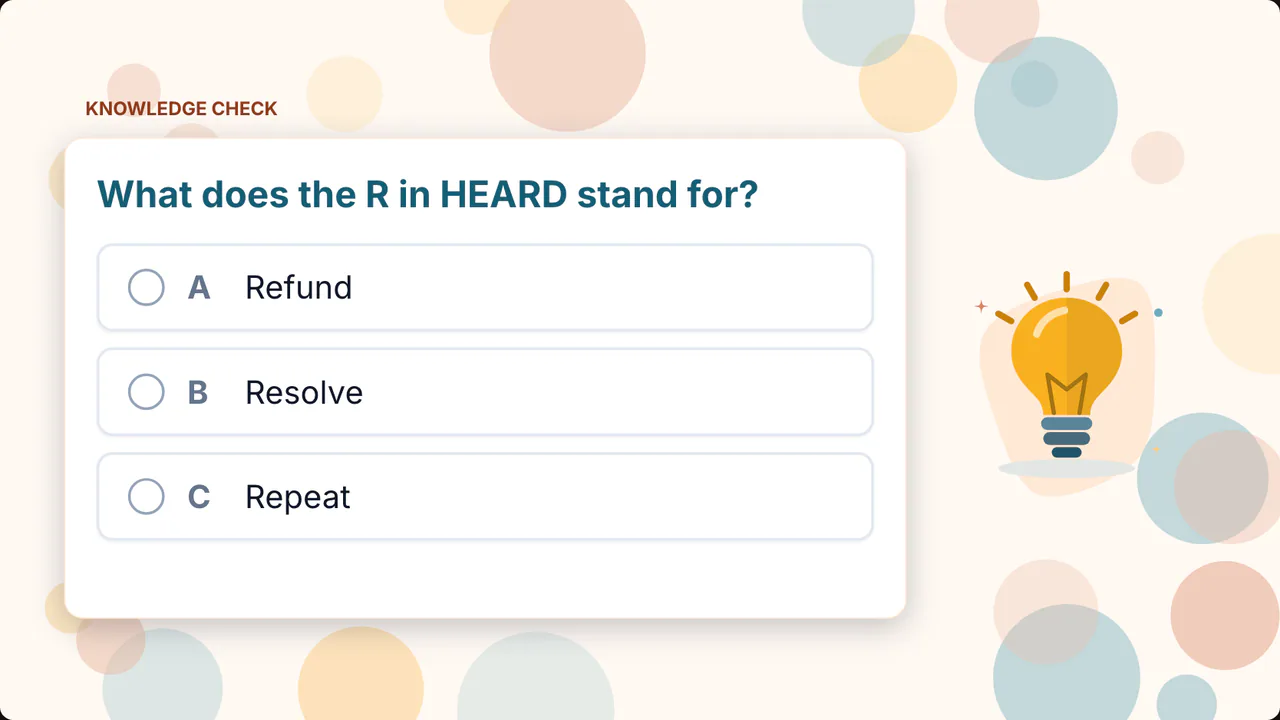
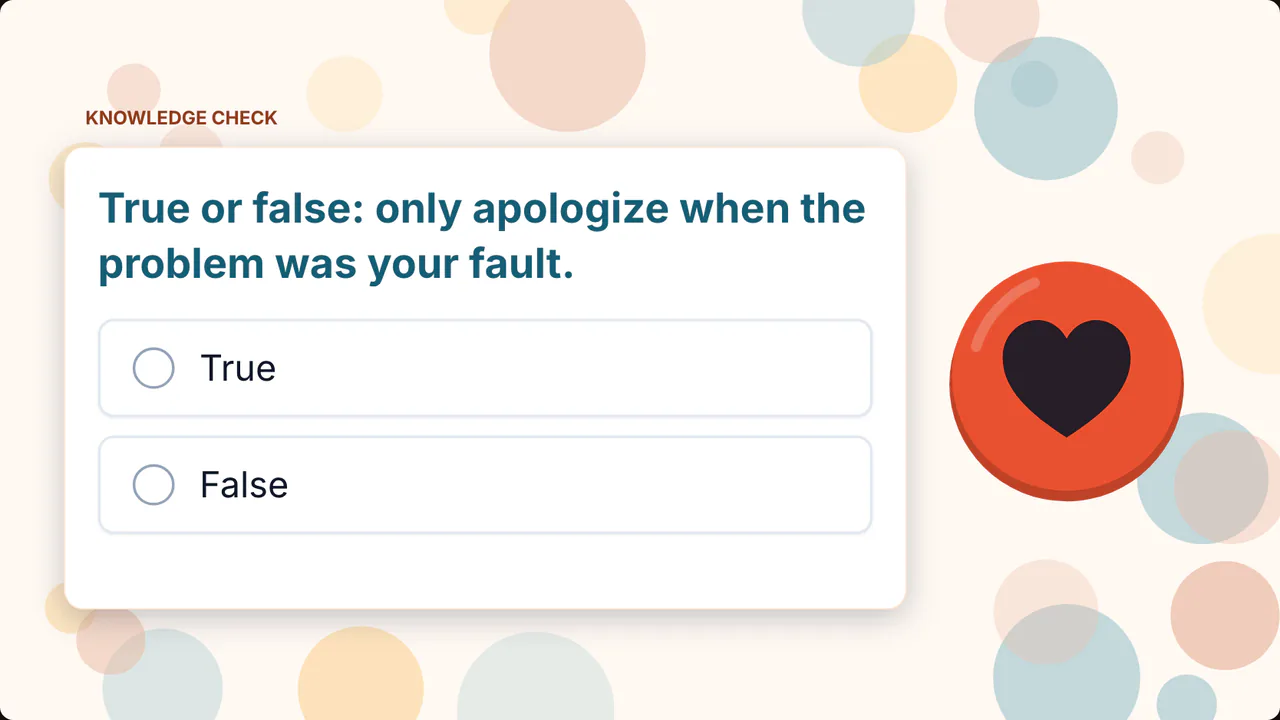
A quiz and a reflection
Three questions with an 80% pass mark, then learners write what they would do differently with their own last complaint.
After the course, learners can
- Handle a complaint in five steps: hear, empathize, apologise, resolve and diagnose
- Choose words that calm a customer down, and avoid the ones that make it worse
- Own the problem, even when someone else caused it
- Apologise sincerely for the customer’s experience, whoever was at fault
- Act early and personally to keep a customer who is about to leave
Made for
- Customer service teams
- One method for every complaint, whatever the channel.
- Front desk and hospitality
- Calm an unhappy guest and keep them coming back.
- Retail staff
- Handle a complaint at the till without passing it on.
- Team leaders
- A shared language for coaching after a difficult conversation.
From template to your own course in minutes
Everything in the template can be changed in Lumesson — by hand, or by asking Lume AI.
- 1
Open it in Lumesson
Home ▸ Templates ▸ Turning complaints around. Every slide, question and picture can be changed — on the Free plan too.
Learn more - 2
Use your real complaints
Ask the Assistant: “Rewrite the chat and the branching scenario around a late furniture delivery, use our refund rules and add a question on when to escalate to a team lead.” It edits the real course and lists what it changed.
Learn more - 3
Grow the branching scenario
Add decisions, outcomes and consequences on the story map, so learners practise a whole conversation, not one reply.
Learn more - 4
Add a service character
Amara, a retail associate with a name badge, can play the person handling the complaint — with 16 poses and expressions to react to each choice.
Learn more - 5
Narrate and caption it
Natural AI voices or your Mac’s own voices for every slide, so learners hear the tone as well as the words, and captions for the whole course in one step.
Learn more - 6
Translate it for every team
A copy in Spanish, French or Portuguese, with its narration voiced again and a list of anything to check.
Learn more - 7
Publish to your LMS
SCORM 1.2 or 2004, xAPI, cmi5 or HTML5. Completion and the quiz score go to your LMS.
Learn more
Turning complaints around: the details
| Length | About 20 minutes |
|---|---|
| Structure | 4 parts, 17 slides |
| Interactions | Step by step, Diagram |
| Assessment | 3 questions: Multiple choice, True or false |
| Results | A results slide with the learner’s score and pass or fail |
| Publish to | SCORM 1.2, SCORM 2004, xAPI, cmi5, HTML5 — or a video, Word or PDF |
| Phones | A phone layout for every slide in one click |
| Language | English — translate the whole course with AI in one step |
| Editing | Every slide, picture, question and setting can be changed |
| Price | Free with Lumesson (the Free plan adds a small “Made with Lumesson” mark) |
Other courses to start from
 Customer serviceGreat service by chat and emailA free live chat and email support course: robotic vs human replies, a four-step reply, a chat to answer, a timed game, a checklist and a quiz. Play it now.
 OnboardingEmployee onboardingA free employee onboarding course for a new hire’s first week: values, a buddy, the first 90 days, a first-day plan, a scenario and a quiz. Play it now.
 IT & softwareGetting started with a new appA free software training course for any new app: a screen tour, tasks on screenshots, click-on-the-screen practice, shortcuts and a graded quiz. Play it now.
Read more
Customer service training that changes conversations: ideas, examples and a course you can build
Customer service training that works: practise real conversations in branching scenarios, an empathy method, role-play and quizzes for frontline staff.
Read the guideGuideHow to write branching scenarios that change what people do
A practical guide to branching scenarios for training: choose the moment, map the conversation, write believable replies, coaching and endings.
Read the guideGuideWhat is microlearning? A definition, 10 examples and how to make it
What is microlearning? A clear definition, when it works and when it doesn’t, 10 microlearning examples, and how to design short lessons for phones and an LMS.
Read the guideFrequently asked questions
Is this complaint handling training template free?
Yes. Every course template comes with Lumesson, including the Free plan, which has every authoring feature. Courses published on Free carry a small “Made with Lumesson” mark; a one-time Lifetime licence removes it.
Can I upload it to my LMS?
Yes. Publish it as SCORM 1.2, SCORM 2004, xAPI or cmi5 and upload the package to your LMS: it reports completion and the quiz score. You can also publish HTML5 for a website or intranet.
What is the HEARD method?
A five-step way to handle a complaint, used widely in hospitality: Hear the customer out, Empathize, Apologize, Resolve the problem, then Diagnose why it happened. The course teaches each step and has learners practise it in a chat, a game and a branching scenario.
Does it cover complaints by phone, email and in person?
Yes. The method works on every channel: the course has a live chat, a phone call and an email reply in its scenarios, and a hotel front-desk case.
Can I add more branches to the scenario?
Yes. Add decisions and outcomes on the story map, use variables to track choices, and show different feedback for each path.
How long does the course take?
About 20 minutes. The chat, the game and the branching scenario also work on their own as a short refresher before a shift.
Make “Turning Complaints Around” your own
Download Lumesson free for Mac, open the template from Home ▸ Templates and change anything — by hand or by asking Lume AI.