Lumesson
Customer service training that changes conversations: ideas, examples and a course you can build
Every customer service team knows the right words. The hard part is finding them when a customer is angry, the queue is long and the policy says no. Good customer service training lets people practise exactly those moments until the right response comes naturally. This guide covers the skills to train, a simple empathy and de-escalation method, practical customer service training ideas, and how to build a course with branching scenarios, role-play and a quiz.

What customer service training is — and why lectures do not work
Customer service training teaches the people who deal with customers — in a store, on the phone, by chat or email — how to understand what the customer needs, solve the problem and leave them feeling well treated, even when the answer is not the one they wanted. It covers product and policy knowledge, the tools of the job and, above all, the conversation itself.
The conversation is where most training falls short. A slide that says “show empathy” is easy to agree with and hard to apply. People learn conversations the way they learn to drive: by doing it, making mistakes and getting feedback. That is why the best customer service training courses spend most of their time on practice — scenarios, role-play, real examples — and very little on explanation.
A simple shape for a 20-minute customer service training course:
- 2 minutes — why it matters: what a good or bad experience means for your customers and your team, ideally with your own numbers or a real customer quote.
- 5 minutes — the method: three to five steps, and the words that go with each.
- 10 minutes — practice: a branching scenario, a role-play, a sorting activity.
- 3 minutes — check and commit: a few questions and one thing to try on the next shift.
The rest of this guide follows that shape.
The customer service skills worth training
Customer service skills training usually focuses on a handful of skills that make the biggest difference:
- Active listening — letting the customer finish, asking a clarifying question, repeating back what you heard.
- Empathy — naming the feeling (“that’s really frustrating”) before jumping to the fix.
- Positive language — saying what you can do instead of what you can’t.
- De-escalation — staying calm, lowering the temperature and avoiding the phrases that make things worse.
- Problem solving and ownership — finding a fix, saying exactly what happens next, and following through.
- Product and policy knowledge — knowing the answer, or where to find it fast.
- Written service — clear, friendly replies by chat and email.
Pick two or three for each course. A 20-minute course that really changes how people listen beats an hour that touches everything once.
1. Give people a simple empathy and de-escalation method
Under pressure, people fall back on habits. A short, memorable method gives them a better habit to fall back on. Lumesson’s customer service template uses LEAP:
- Listen — let the customer finish. Take notes and do not interrupt.
- Empathize — acknowledge the feeling: “I understand how frustrating this is.”
- Act — offer a clear solution and say exactly what happens next.
- Follow up — check the problem is solved and thank them for their patience.
Whatever method you choose — your own, or one your company already uses — keep it to three to five steps and teach it with the words that go with each step. A Words that help, words that hurt slide is surprisingly powerful: “Let me find out for you” next to “That’s not my department”; “Here is what I can do” next to “There’s nothing I can do”; and never “Calm down.” Flip cards that turn a negative phrase into a positive one (“No, we can’t” becomes “What we can do is…”) make good quick practice.
2. Practise real conversations with branching scenarios
A branching scenario turns the method into practice. The customer says something, the learner chooses a reply, the customer reacts, and the conversation goes somewhere better or worse. Because mistakes cost nothing, people choose the reply they would really give — and learn from seeing where it leads.
Here is a first step, with Amara, a retail associate, at the returns desk:
A customer puts a jacket on the counter: “I bought this five weeks ago and the zip is already broken. Don’t tell me it’s past the return date.”
- A. “I’m sorry, our returns policy is 30 days.” — Coaching: True, but it ends the conversation. The customer hears “no” and nothing else. 0 points.
- B. “That’s really annoying after five weeks. Let me look at the zip — a fault like this may be covered even after 30 days.” — Coaching: You acknowledged the feeling and moved to what you can do. +10 points.
- C. “Let me get my manager.” — Coaching: Sometimes right, but you have not listened yet, and the customer has to explain everything twice. +3 points.
Each reply leads to a different next step, and a poor first reply can still be rescued, which is realistic and teaches more than instant failure. Our guide on how to write branching scenarios covers mapping, coaching and endings in detail.

A scenario as learners see it: the customer speaks, and every reply leads somewhere different.
3. Build the scenario with characters people recognise
In Lumesson’s scenario editor you write the conversation, not slides: steps and endings in a list, the slide each step becomes beside it, and for every reply its coaching, its points and where it leads — up to four replies per step. Choose good, neutral and bad endings; “Try again” and “Continue” are built in. Make the scenario practice (coaching, no score) or graded, in which case the best score goes to your LMS like a quiz.
Faces make it feel like a real conversation. The illustrated characters include Amara, a retail associate; Ravi, a frontline associate; Daniel, from customer success; and managers and team leads for the escalation step. Each comes in half body with a large, clear face and 16 or more expressions — so the customer can arrive frustrated, look relieved after a good reply and annoyed after a poor one — and in full body for scenes.
Short on time? Choose Scenario when you create a course with Lume AI, or ask the Assistant: “Write a three-step scenario where a store associate handles a late return, with coaching and a good, a neutral and a bad ending.” Then replace the replies with what your people really say.

Steps, replies, coaching and points, side by side with the slide each step becomes.
4. Role-play the tone, not just the words
The same sentence can calm a customer or make them angrier, depending on how it is said. A role-play slide lets learners try different tones and see the reaction. In Lumesson’s Role-play layout, two characters face each other; the learner chooses a tone — say, rushed, scripted or warm — and sees the customer’s reaction and a coach’s note for each. It is built from normal layers and triggers, so you can add a fourth tone or change the coaching in minutes.
Online role-play does not replace practising with a colleague; it prepares people for it. A good pattern for a team session:
- Everyone does the scenario and the role-play slide on their own.
- In pairs, one person plays the customer from the scenario, the other responds using the method.
- Swap, then discuss: which words worked, and which felt unnatural?
For written service, the Great service by chat and email template adds before-and-after replies, a four-step written reply and a before-you-send checklist.

A role-play slide: each tone of voice brings the customer’s reaction and a coach’s note.
5. Check understanding with a short quiz
End with a short quiz, but make the questions about situations, not definitions. “A customer says the room is noisy. What do you say first?” tests judgment; “What does the E in LEAP stand for?” only tests memory. Use both sparingly — three to six questions is plenty — and give feedback that explains why, in the words of your method.
Lumesson has 20 question types, from multiple choice and true/false to matching, sequence and drag-and-drop. Draw questions from a bank so every attempt is different, allow a retry, and finish with a results slide and a certificate. A reflection slide at the very end — “Think of a difficult conversation you had recently. What would you do differently?” — helps the method move from the course into the next shift.

A situation, three believable answers — and feedback that explains why.
Customer service training ideas and examples
Looking for customer service training ideas beyond the classic course? A few that work well online:
- “The worst call of the month.” Turn a real (anonymised) difficult conversation into a scenario every month.
- Reframe the phrase. Flip cards with the phrases your team says too often, and better alternatives on the back.
- Beat the clock. A timed game slide: match customer questions to the right answer before time runs out.
- Sort it. Drag requests into “I can solve this”, “I need to check” and “Escalate”.
- Listen first. A short narrated clip of a customer explaining a problem, then a question about what they actually need.
- A call turned around. A short video of a colleague handling a difficult customer well, with three things to notice.
- The system, too. A software simulation of your help desk or CRM, so people can log a complaint correctly while they talk.
- Product of the week. A three-minute quiz on one product and the questions customers ask about it.
Lumesson’s learning games — memory match, sort into buckets, beat the clock, put it in order, fill in the blanks and a quiz board — are ready-made slides you fill with your own content.
Customer service training for frontline staff
Frontline staff — in stores, hotels, restaurants and contact centres — rarely have an hour at a desk. Training for frontline staff has to fit into a shift:
- Short modules. Ten minutes, one skill, one scenario. See our guide to microlearning.
- Phones first. Every Lumesson slide gets a real phone layout in one click, scenarios and quizzes included, with buttons big enough to tap.
- Voice and captions. Natural AI narration lets people listen; captions help in a noisy back room.
- Their language. Translate the course into a copy that keeps its layout and interactions, and re-voice the narration — so a scenario lands in the language people actually serve customers in.
- Team huddles. Publish the course as an MP4 and play it at the start of a shift, then do the role-play in pairs.
- Coaching on the floor. Give team leads the scenario too. When they see a great (or a difficult) conversation, they can point back to the method by name: “that was a perfect Empathize step”.
Track it like any other course: publish to SCORM, xAPI or cmi5, and your LMS records completion, quiz scores and graded scenario scores for each person.
Start from the Customer service template
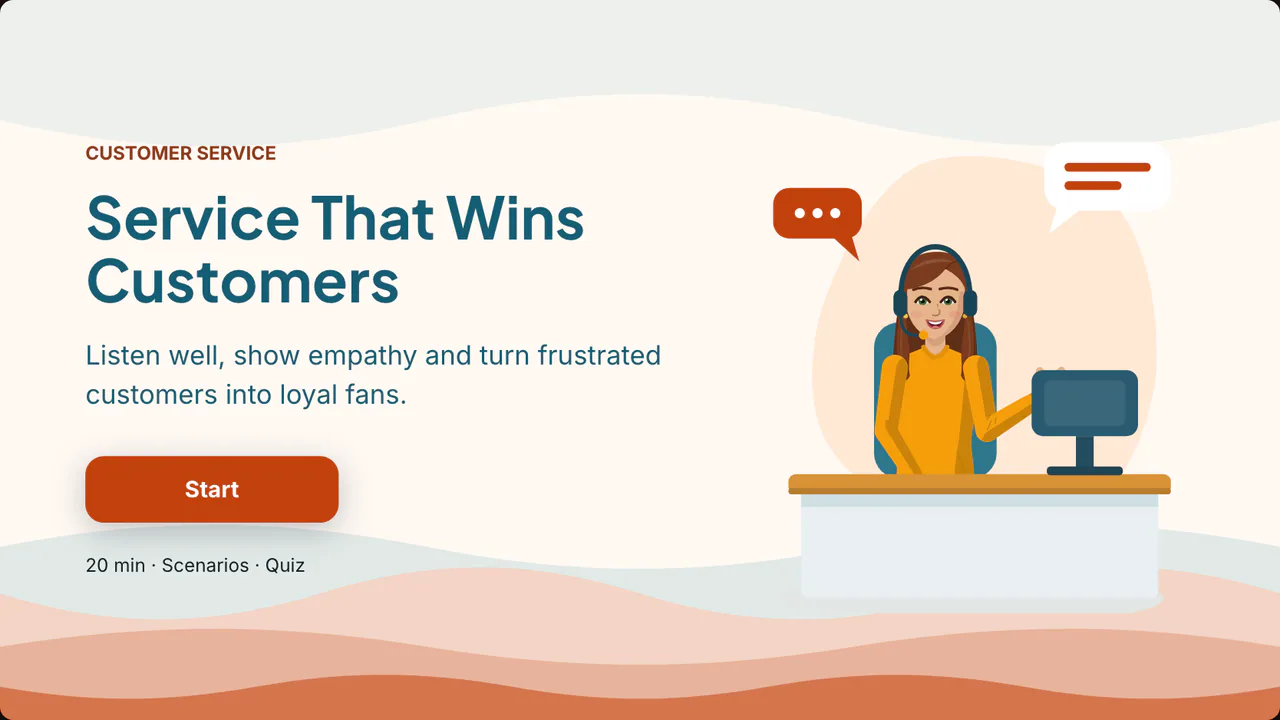
You do not need to build a customer service training course from scratch. In Lumesson, the Customer service skills template — “Service That Wins Customers” — is a 20-minute course with everything above: why service matters, the LEAP method, a “Listen first” slide, helpful and unhelpful language, reframing flip cards, a video slide, a branching scenario about a late delivery, a dialogue to talk through, key takeaways, a three-question quiz, a results slide and a reflection.
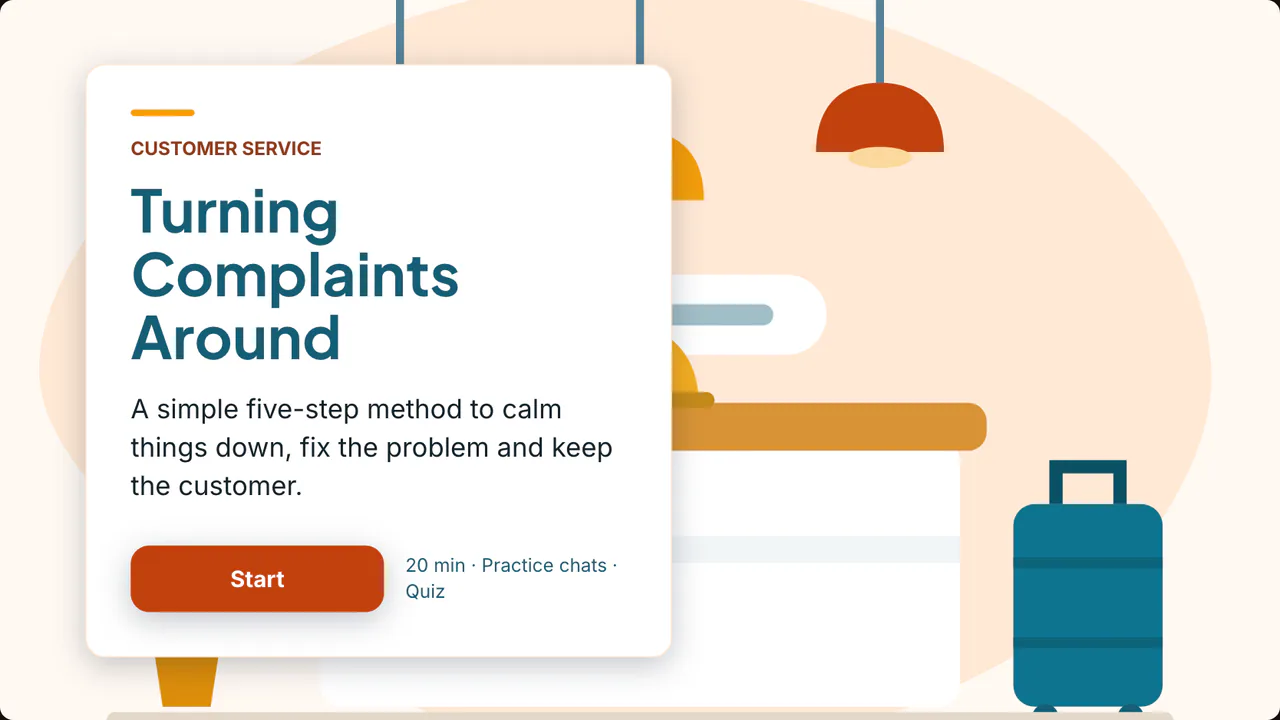
Two more templates go further: Turning complaints around teaches the HEARD method for complaints in person, by phone or chat, with chat practice, a quick-fire game and a real case; Great service by chat and email focuses on written replies. Add your brand kit, swap in Amara or another character, replace the examples with your own products and policies, and publish to your LMS with SCORM, xAPI or cmi5.
A customer service training checklist
- Two or three skills per course, chosen from real customer feedback.
- One simple method, with the words that go with each step.
- At least one branching scenario on a moment people get wrong, with believable replies.
- A role-play slide, followed by practice in pairs.
- A short quiz on situations, with feedback that explains why.
- Phone layouts, narration and captions for frontline staff.
- A new scenario every month from real conversations.
Want to try it? Download Lumesson for Mac and open the Customer service skills template.