 Lumesson
Anti-harassment training template
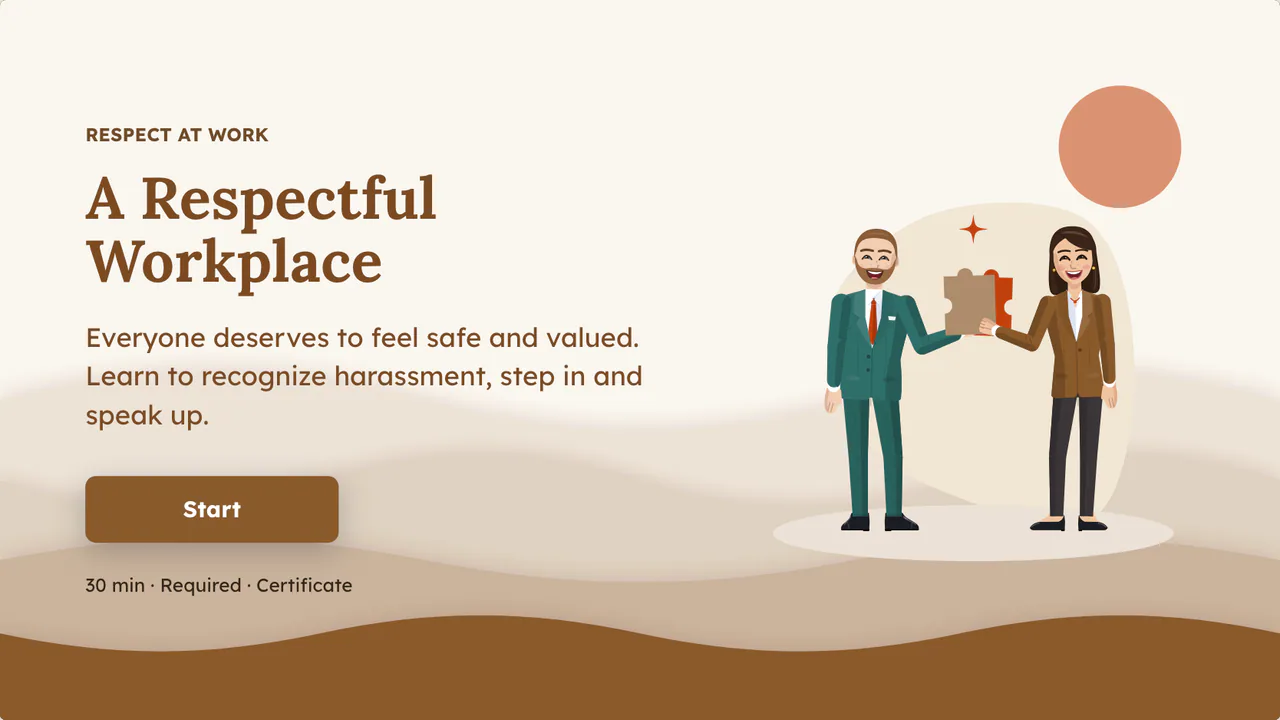
A 30-minute respectful workplace course: verbal, physical and online harassment, why impact matters more than intent, the 4 Ds of stepping in as a bystander, and jokes in a team chat that someone has to stop — then how to report, where to get support and a three-question quiz. Play it below, then make it yours.
- 30 minto complete
- 15slides in 4 parts
- 3questions, 3 kinds
- SCORMxAPI · cmi5 · HTML5
Already have Lumesson? Open this template in the app
 Play the course
Take “A Respectful Workplace” as a learner
This is the real course, published from Lumesson as HTML5. Click through it, try every activity and take the test — nothing you do is recorded.
Open full screenWorks on phones and tablets too
15 slides in 4 parts
A free anti-harassment training course: forms of harassment, the 4 Ds of being an upstander, how to report, a team-chat scenario and a quiz. Play it now.
Introduction
2 slidesRecognize
3 slidesRespond
5 slidesAssessment
5 slidesA look at the course
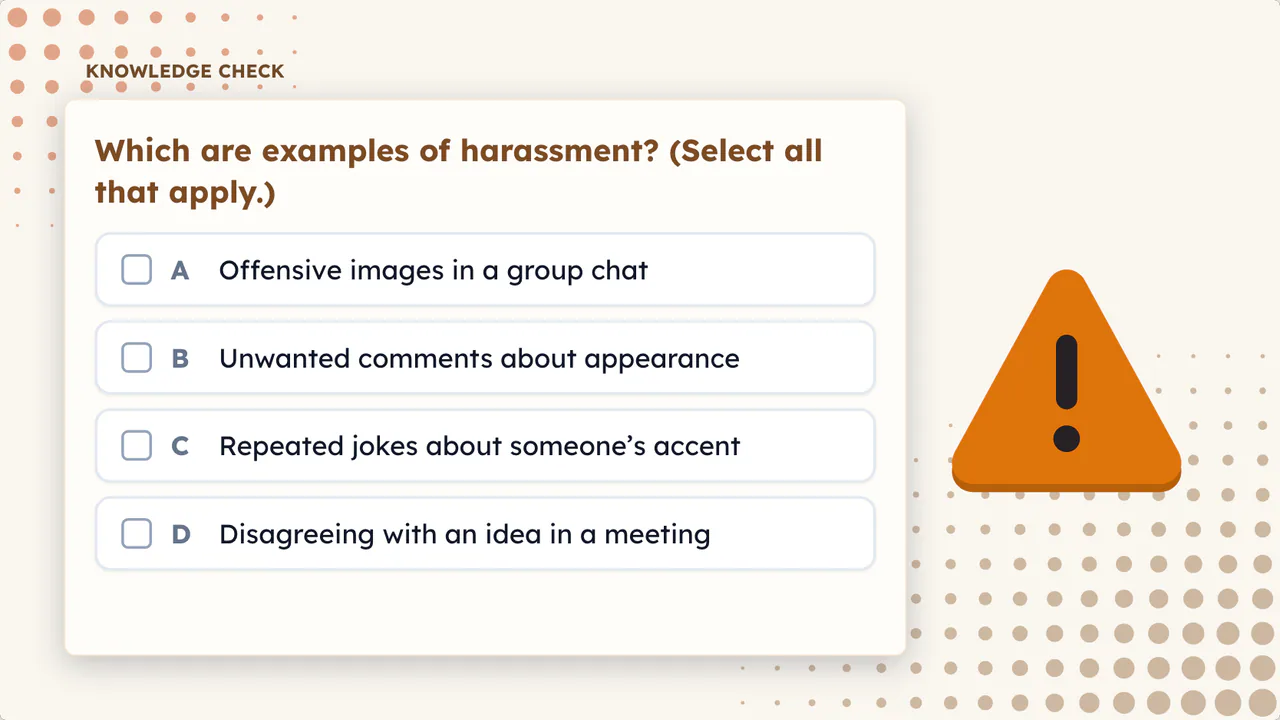
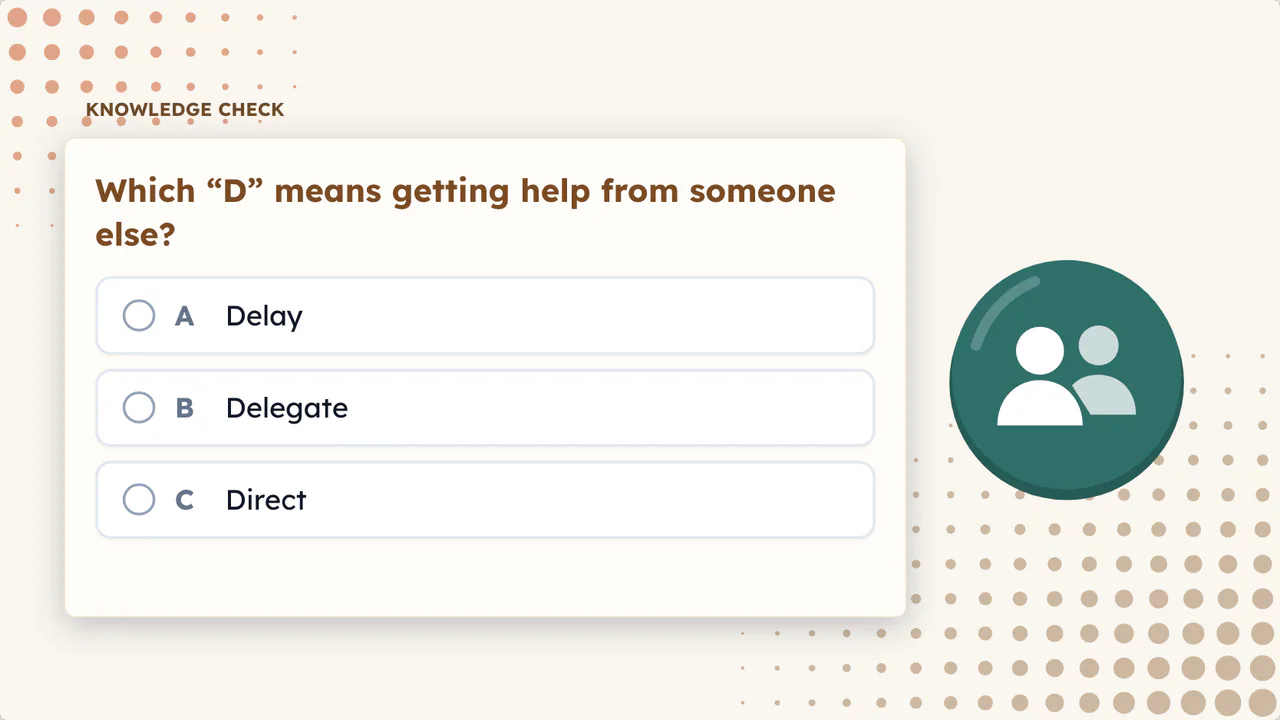
Learning by doing, not by reading
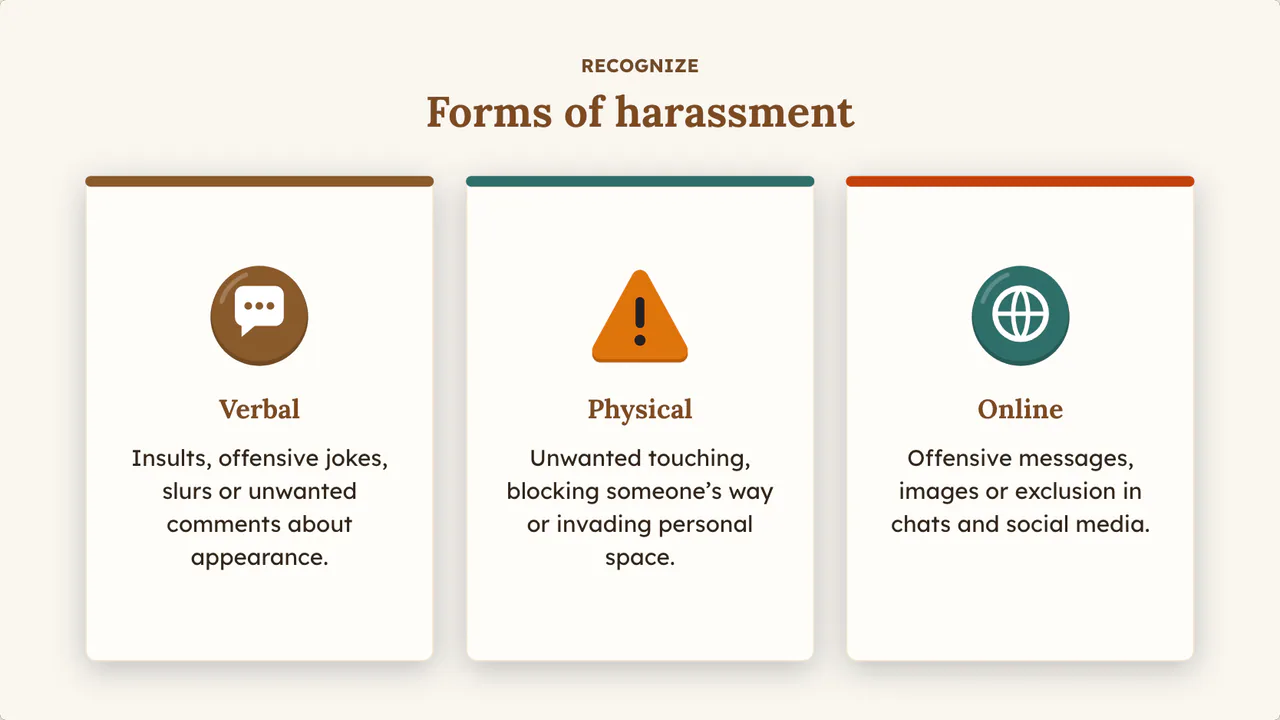
Forms of harassment
Verbal, physical and online, each on its own card with examples — from offensive jokes to exclusion in a group chat.
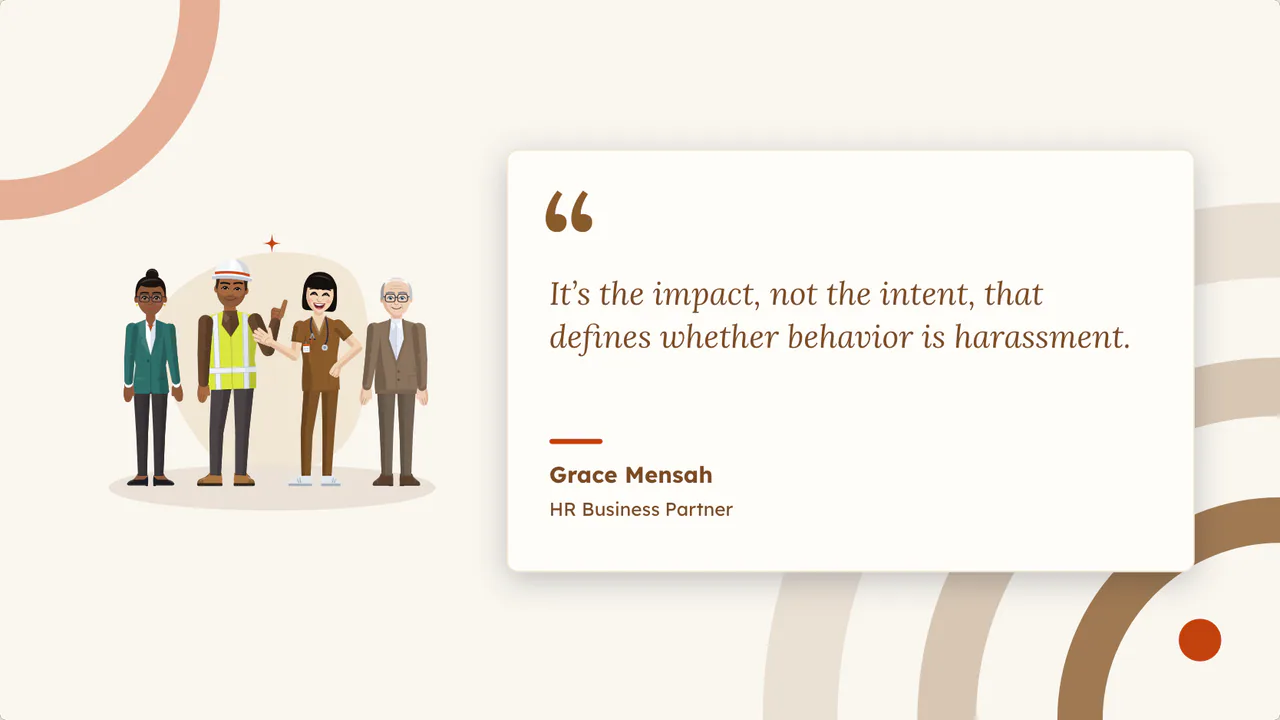
Impact over intent
“It’s the impact, not the intent, that defines whether behavior is harassment.” — a quote from an HR Business Partner, tested again in the quiz.
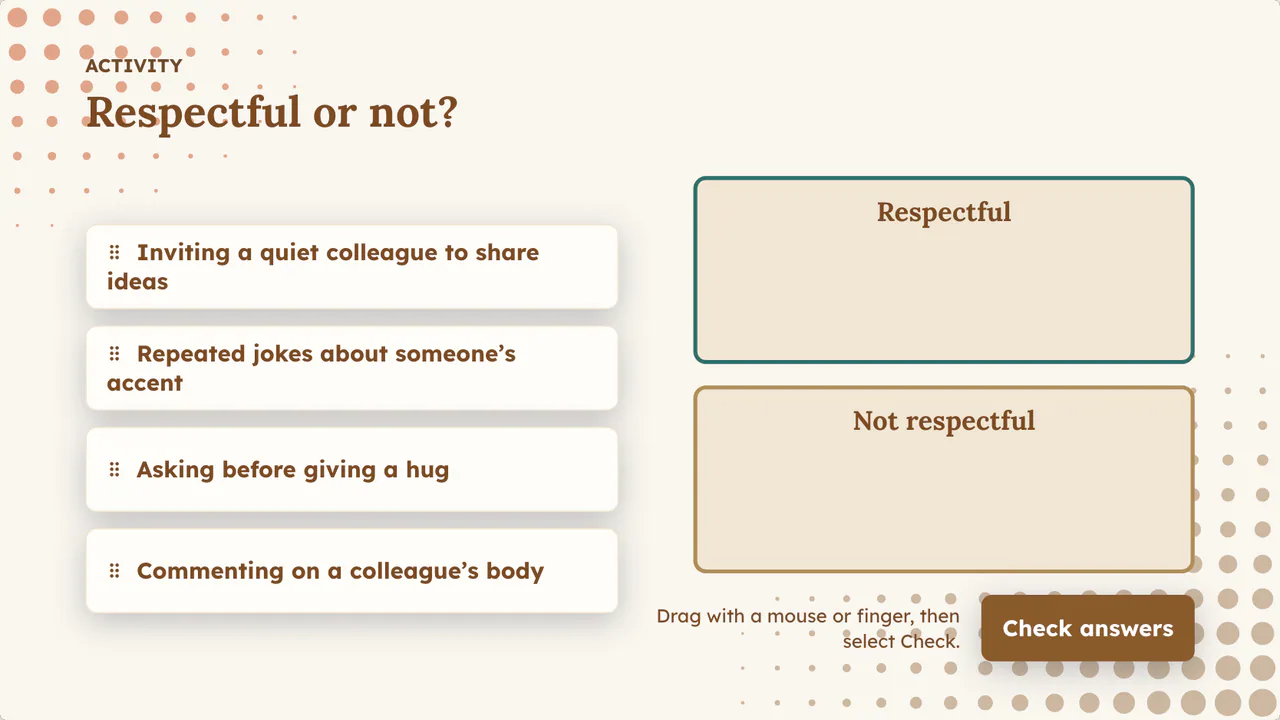
Respectful or not?
A sorting activity: drag each behaviour — inviting a quiet colleague to share ideas, jokes about an accent — to the right side.
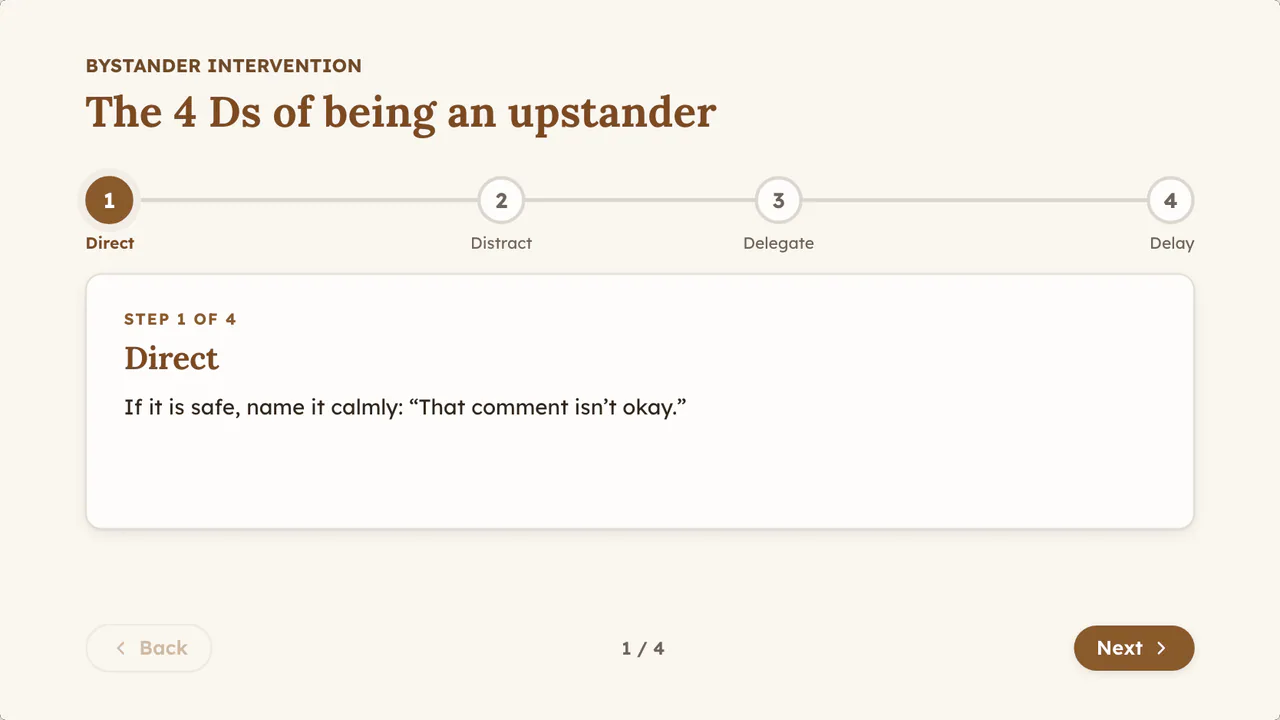
The 4 Ds
Direct, Distract, Delegate, Delay: four safe ways to step in, one step at a time, each with what to say or do.
The team chat
A colleague keeps posting jokes about Lea’s religion and others react with laughing emojis. Learners decide what to do — and see why silence feels like agreement.
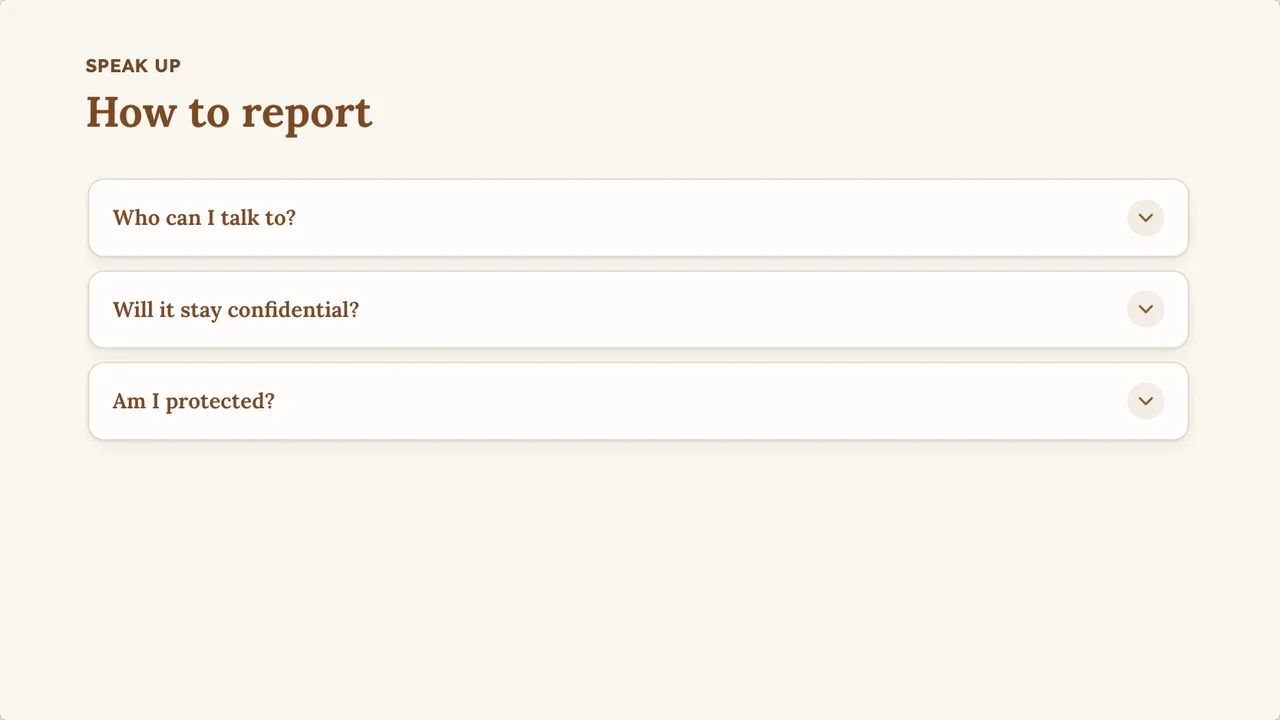
How to report
Who can I talk to? Will it stay confidential? Am I protected? Learners open each answer.
You are not alone
Three places to get support — the People team, a 24/7 speak-up line and employee assistance — and where to get help, now or anonymously.
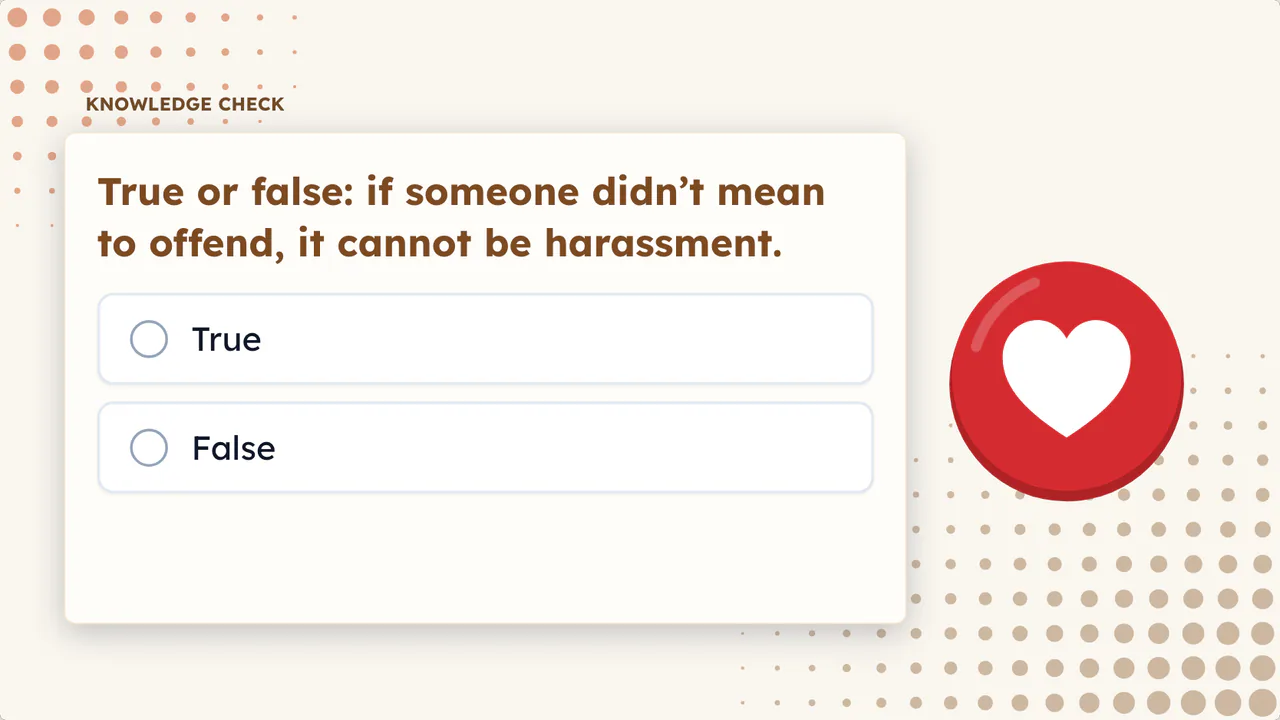
A quiz of three kinds
True or false, multiple response and multiple choice, with an 80% pass mark, review, retry and a certificate.
After the course, learners can
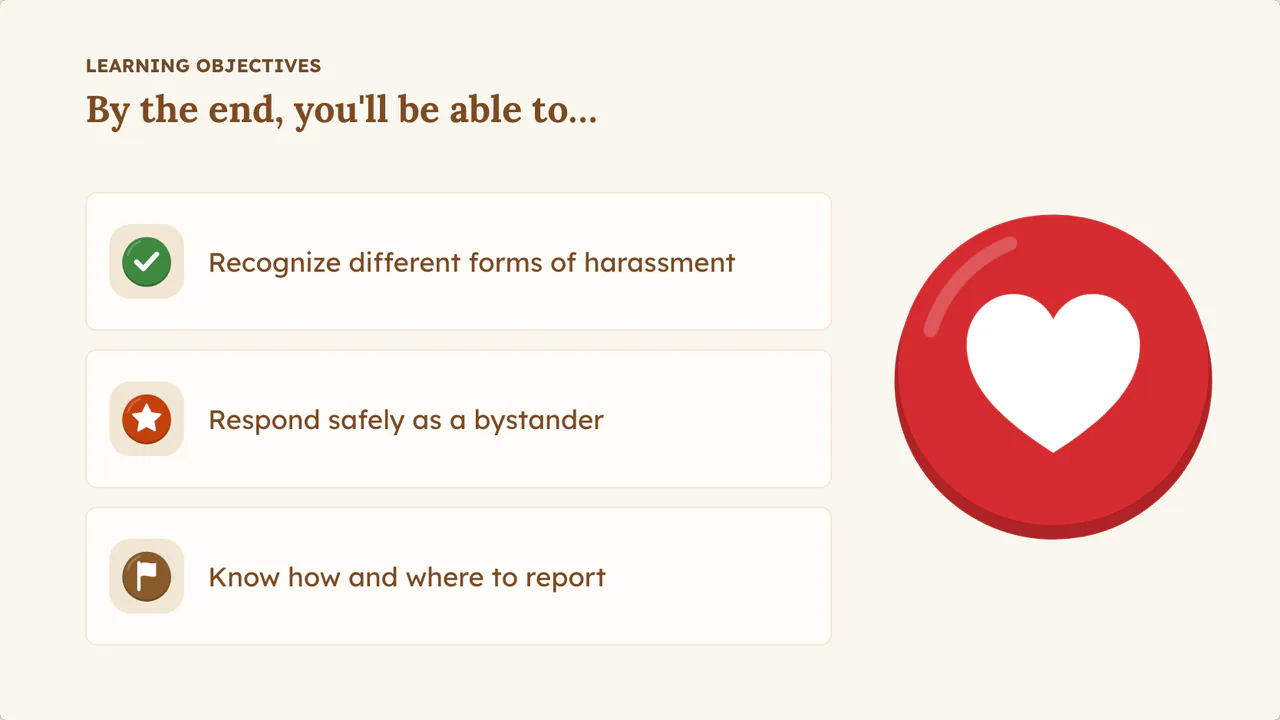
- Recognise verbal, physical and online harassment
- Explain why the impact of behaviour, not the intent behind it, defines harassment
- Step in safely as a bystander with the 4 Ds: Direct, Distract, Delegate, Delay
- Know who to talk to, how reports stay confidential and that people who report are protected
- Find support: the People team, a confidential speak-up line and employee assistance
Made for
- Every employee
- What harassment looks like, and what to do when you see it or it happens to you.
- Managers
- The people most likely to hear a report first — and expected to act on it.
- HR & People teams
- A ready-made course to add your own policy, procedure and contacts to.
- New starters
- The standard of behaviour, set in the first week.
From template to your own course in minutes
Everything in the template can be changed in Lumesson — by hand, or by asking Lume AI.
- 1
Open it in Lumesson
Home ▸ Templates ▸ Respectful workplace. Every slide, question and picture can be changed — on the Free plan too.
Learn more - 2
Put it in your brand
Pick a brand kit and your logo, colours and fonts go onto every slide at once.
Learn more - 3
Add your policy and procedure
Ask the Assistant: “Add our complaint procedure and the definition of sexual harassment from our policy, and a scenario about a comment at a team dinner.” It edits the real course and lists what it changed.
Learn more - 4
Put in your real contacts
Replace the sample People team, speak-up line and employee assistance addresses with your own.
Learn more - 5
Add a scenario for managers
Someone reports harassment to their manager: build a conversation with several steps, coaching on every reply and different endings.
Learn more - 6
Narrate and caption it
Natural AI voices or your Mac’s own voices for every slide, and captions for the whole course in one step.
Learn more - 7
Translate it for every team
A copy in every language your people speak, with its narration voiced again and a list of anything to check.
Learn more - 8
Publish to your LMS
SCORM 1.2 or 2004, xAPI, cmi5 or HTML5. Completion and the quiz score go to your LMS, so you can show who was trained.
Learn more
Respectful workplace: the details
| Length | About 30 minutes |
|---|---|
| Structure | 4 parts, 15 slides |
| Interactions | Step by step, Accordion |
| Assessment | 3 questions: True or false, Multiple response, Multiple choice |
| Results | A results slide with the learner’s score and pass or fail |
| Publish to | SCORM 1.2, SCORM 2004, xAPI, cmi5, HTML5 — or a video, Word or PDF |
| Phones | A phone layout for every slide in one click |
| Language | English — translate the whole course with AI in one step |
| Editing | Every slide, picture, question and setting can be changed |
| Price | Free with Lumesson (the Free plan adds a small “Made with Lumesson” mark) |
Other courses to start from
 ComplianceCybersecurity awarenessA free cybersecurity awareness training course: passwords, MFA, spotting phishing, a secure desk, a timed game and a four-question quiz. Play it now.
 ComplianceCode of conductA free code of conduct training course: integrity, conflicts of interest, gifts and speaking up, a supplier scenario, a quiz and a signed acknowledgement.
 ComplianceData privacy & GDPRA free GDPR training course: personal and sensitive data, four core principles, data subject rights and a data breach in 72 hours, with a quiz. Play it now.
Read more
Compliance training people actually finish: what it is and how to build it
What compliance training is, what employee compliance training must cover, and how to build a compliance training program people finish — with LMS tracking.
Read the guideGuideHow to write branching scenarios that change what people do
A practical guide to branching scenarios for training: choose the moment, map the conversation, write believable replies, coaching and endings.
Read the guideGuideWhat is microlearning? A definition, 10 examples and how to make it
What is microlearning? A clear definition, when it works and when it doesn’t, 10 microlearning examples, and how to design short lessons for phones and an LMS.
Read the guideFrequently asked questions
Is this anti-harassment training template free?
Yes. Every course template comes with Lumesson, including the Free plan, which has every authoring feature. Courses published on Free carry a small “Made with Lumesson” mark; a one-time Lifetime licence removes it.
Can I upload it to my LMS?
Yes. Publish it as SCORM 1.2, SCORM 2004, xAPI or cmi5 and upload the package to your LMS: it reports completion and the quiz score, so you have a record of who was trained. You can also publish HTML5 for an intranet.
Does it meet legal requirements for harassment training?
It is general respectful workplace training. Some states and countries set rules for harassment prevention training — specific content, length or interactivity — so add your own policy, the legal definitions that apply to you and your complaint procedure, and have it checked before you use it. It is not legal advice.
Is there a version for managers?
The template is written for all employees. Duplicate it and ask the Assistant to add what managers need — how to receive a report, what to do next and what not to promise — with a scenario to practise it.
Can I change the scenario?
Yes. Rewrite the team-chat scenario for your workplace, or add more: an in-person comment, a team dinner, a remote meeting — each with choices, coaching and endings.
How long does the course take?
About 30 minutes, including a three-question quiz. Each part can also stand alone as a short refresher.
Make “A Respectful Workplace” your own
Download Lumesson free for Mac, open the template from Home ▸ Templates and change anything — by hand or by asking Lume AI.