Lumesson
Compliance training people actually finish: what it is and how to build it
Compliance training has a reputation problem: long, dull, clicked through once a year. It does not have to be. This guide explains what compliance training is, what employee compliance training usually covers in different industries, and how to build a compliance training program people actually finish — with scenarios instead of policy slides, fair tests, and the records your auditors ask for.

What is compliance training?
Compliance training teaches employees the laws, regulations and internal policies that apply to their work — and, more importantly, how to act on them. It has two jobs at once:
- Prevent harm: stop the data breach, the bribe, the harassment, the fraud before it happens.
- Prove diligence: show regulators, auditors and courts that the organisation trained its people, tested their understanding and kept records.
Most compliance training programs fail at the first job because they are designed only for the second. A course built to produce a completion record tends to read the policy aloud and ask ten easy questions. A course built to change behaviour puts people in the situations where the policy matters and asks them what they would do. The good news: the second kind produces better records too.
Compliance training is rarely one course. New employees take a core set when they join; managers often get extra modules, because they are the ones who receive reports of misconduct and approve exceptions; and people in regulated roles — traders, nurses, anyone handling customer money or personal data — take specialist courses on top. Everyone then refreshes on a schedule. Planning that mix is as important as writing any single course.
What compliance training for employees usually covers
Some topics apply to almost everyone; others depend on your industry and the regulators you answer to.
| Area | Typical topics |
|---|---|
| Every organisation | Code of conduct, anti-harassment and a respectful workplace, data privacy, cybersecurity and phishing, health and safety, speaking up |
| Financial and bank compliance training | Anti-money laundering (AML), know your customer (KYC), sanctions, fraud, anti-bribery and corruption, conflicts of interest, market conduct, complaints handling |
| Healthcare compliance training | Patient privacy and confidentiality, infection control and hand hygiene, consent, record keeping, incident reporting |
| Other regulated work | Food safety, environmental rules, export controls, product safety, transport and driving rules |
Regulatory compliance training is the part a law or a regulator requires — often with a fixed frequency, such as annual refreshers, and specific record-keeping. Check with your legal or compliance team which topics are mandatory for which roles, and how long you must keep the records. Then design for the people, not just the requirement.
Why most compliance training fails
Ask employees about their last compliance course and you will hear the same complaints: too long, too abstract, nothing to do with my job, a test I could pass without reading. Underneath them are four design mistakes:
- Policy instead of practice. Slides restate the policy; nobody practises applying it to a grey-area case.
- One size for everyone. The warehouse team and the finance team get the same anti-bribery course, so it fits neither.
- Easy tests. When the correct answer is the longest, most sensible-sounding one, a test measures reading speed, not judgment.
- Annual cramming. One long course a year, forgotten by spring.
Each of these has a fix you can build into the course itself.
1. Turn each policy into the decisions people face
For every policy, ask: where in a normal working week does someone have to apply this — and where do they get it wrong? A gifts policy becomes “a supplier who is bidding for a contract offers you concert tickets”. A data privacy policy becomes “a customer calls and asks you to read back the address on the account”. A KYC procedure becomes “a new client is in a hurry and promises to send the ID documents next week”.
Write the learning goal as the behaviour, not the topic: “Declines gifts from bidders during a tender and logs the offer in the gift register.” Collect three to five of these decisions per course. They become your scenarios and your test questions, and everything else — the full policy text, the definitions — goes into the player’s resources and glossary, where learners can look it up.
2. Replace policy slides with scenarios
A branching scenario is the most effective format for compliance because grey areas are exactly where people need practice. The learner reads a situation, chooses a reply, sees the consequence and gets coaching. For example, from a bank compliance training course:
A long-standing customer asks to deposit a large amount in cash and says: “Can we split it over a few days? I don’t want the paperwork.”
- A. “Of course, let’s do part today.” — Coaching: Splitting deposits to avoid reporting is a classic red flag. Don’t help, and don’t tip the customer off.
- B. “I need to process it as one deposit, with the usual checks.” Then report your concern internally. — Coaching: Correct. Follow the procedure and escalate through the right channel.
- C. “I’d better ask my manager first.” — Coaching: Reasonable, but don’t leave the customer with the impression that splitting is possible.
In Lumesson’s scenario editor you write exactly this: steps and endings in a list, up to four replies per step, each with coaching, points and where it leads. Graded scenarios keep the learner’s best score and report it to the LMS like a quiz. Our guide on writing branching scenarios goes deeper.
3. Knowledge checks, question banks and pass marks
Tests in compliance training should be fair, varied and hard to game. A few rules of thumb:
- Ask about situations, not definitions. “Which of these is a conflict of interest?” beats “What is the definition of a conflict of interest?”
- Make wrong answers plausible. Each one should be something a real person might believe.
- Use question banks. Draw a set number of random questions from each bank, so every attempt is different and answers cannot be passed around.
- Set a passing score that reflects the risk. Many teams use 80%; for a code of conduct some require 100%, with retries allowed.
- Shuffle answers, and limit attempts if your policy requires it.
Lumesson has 20 question types — multiple choice and response, true/false, matching, sequence, hotspots, drag-and-drop and more, plus survey types for feedback. You can bring existing question lists in from a spreadsheet instead of retyping them, and end with one of seven results layouts. See the quiz maker for every type.

A knowledge check in the course player — situations, not definitions.
4. Acknowledgement, certificates and tracking in your LMS
The records are what turn training into evidence. Plan them before you build:
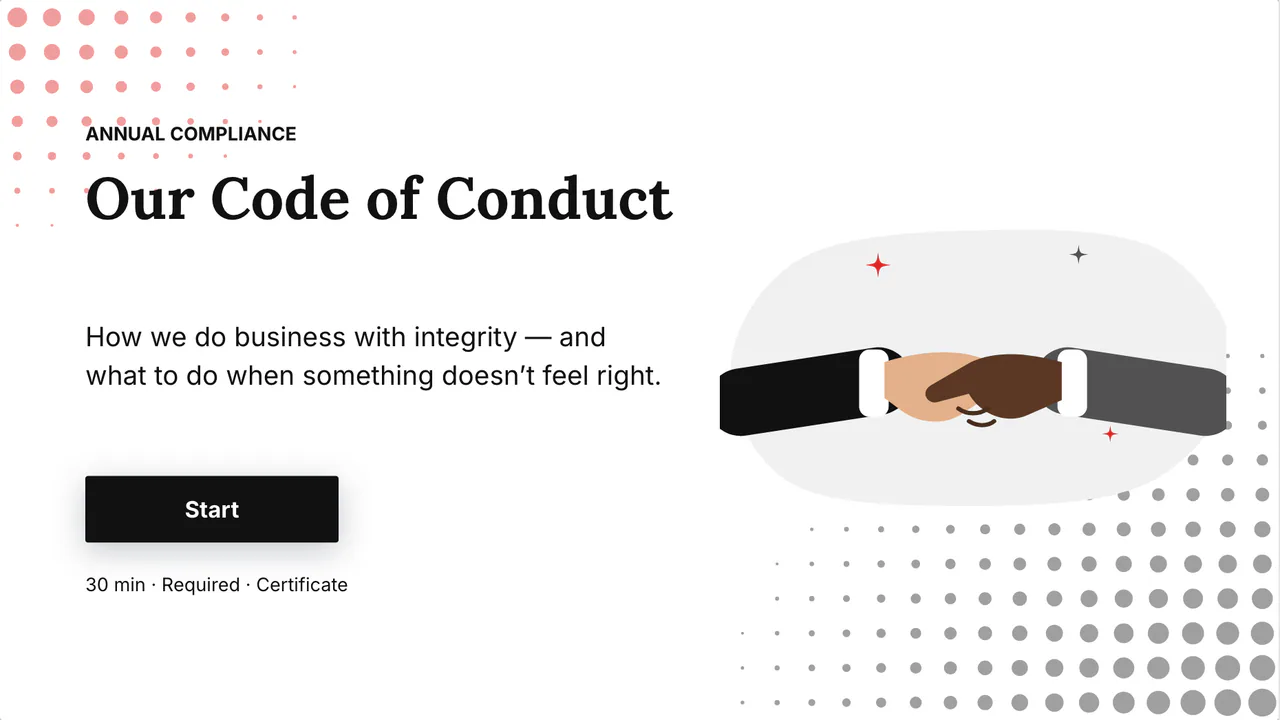
- An acknowledgement: a final slide where learners confirm they have read and understood the policy and agree to follow it. In Lumesson’s Code of conduct template, confirming completes the course.
- A certificate with the learner’s name on the results slide, ready to print.
- Completion rules: decide what “complete” means — a number of slides viewed, a passed results slide, or a “Complete course” trigger such as the acknowledgement — and the status your LMS receives: completed, passed or failed.
- The standard your LMS reads: SCORM 1.2 and 2004 work with almost every LMS; xAPI and cmi5 are there when your LMS or learning record store prefers them. Answers to short-answer and essay questions are recorded and sent to the LMS too.
- Restricted navigation if learners must see every slide in order before the test.
If you need to keep a copy of exactly what people were taught, export the course as a Word storyboard or PDF along with each version you publish.

Choose the standard your LMS asks for and decide when the course counts as complete.
5. Make compliance training accessible
Mandatory training has to be possible for everyone it is mandatory for — including people who use a screen reader, navigate by keyboard, are deaf or hard of hearing, or read slowly. In many organisations accessibility is itself a compliance requirement.
Before you publish, Lumesson’s accessibility checker tests every slide against WCAG 2.1 — contrast, alternative text, reading and focus order — gives the course a score and fixes most findings in one click; Lume AI writes the alt text for pictures. In the course player, learners get captions and a transcript, keyboard and screen-reader support, text up to 150% and a high-contrast switch. Add narration for people who prefer to listen, and phone layouts for people who never sit at a desk.

The accessibility checker groups issues by slide, with the WCAG criterion and a quick fix.
6. Plan the annual refresh — and the in-between
Policies change, regulators publish new guidance and last year’s scenario stops feeling fresh. Build the course so that updating it is a morning’s work, not a project:
- Keep the policy text out of the slides as far as you can; link the current policy as a resource.
- Swap scenarios each year. The structure stays; the situation changes, ideally drawn from real cases.
- Refresh the question banks rather than rewriting the test.
- Version every release: give the package a version number when you publish to your LMS.
- Add short refreshers between annual courses — five-minute modules on one decision each. Our guide to microlearning shows how.
If you train in several countries, translate the updated course into a copy that keeps its layout and interactions, or send XLIFF to your translation agency.
From single courses to a compliance training program
One good course is a start. A compliance training program is the system around it: who takes what, when, and how you know it worked. Five pieces make it manageable:
- A training matrix. Rows are roles, columns are courses, cells say “required at hire”, “annual” or “not required”. Everyone in the bank takes the code of conduct; only front-office staff take the detailed KYC module.
- A calendar. Spread annual courses across the year instead of launching everything in January, and schedule refreshers between them.
- Owners. Each course has a subject expert who signs off the content and a date when it is next reviewed.
- Reporting. Agree which LMS reports you will pull — completion by team, pass rates, overdue learners — and who receives them.
- Feedback. Add a two-question survey at the end of each course (a Likert scale and a free-text box are enough) and read the answers. Questions most people get wrong show you where the policy, or the course, is unclear.
For employee compliance training to stay credible, the program also needs a way to react quickly: when an incident happens or a rule changes, a short targeted module within weeks says more about your culture than any annual course.
Compliance training software: what to look for
Compliance training software falls into two camps: libraries of ready-made courses, and authoring tools that let you build courses around your own policies. Libraries are quick but generic; your people will recognise that the scenarios are not about them. An authoring tool takes a little more effort and gives you training that reflects your rules, your systems and your culture.
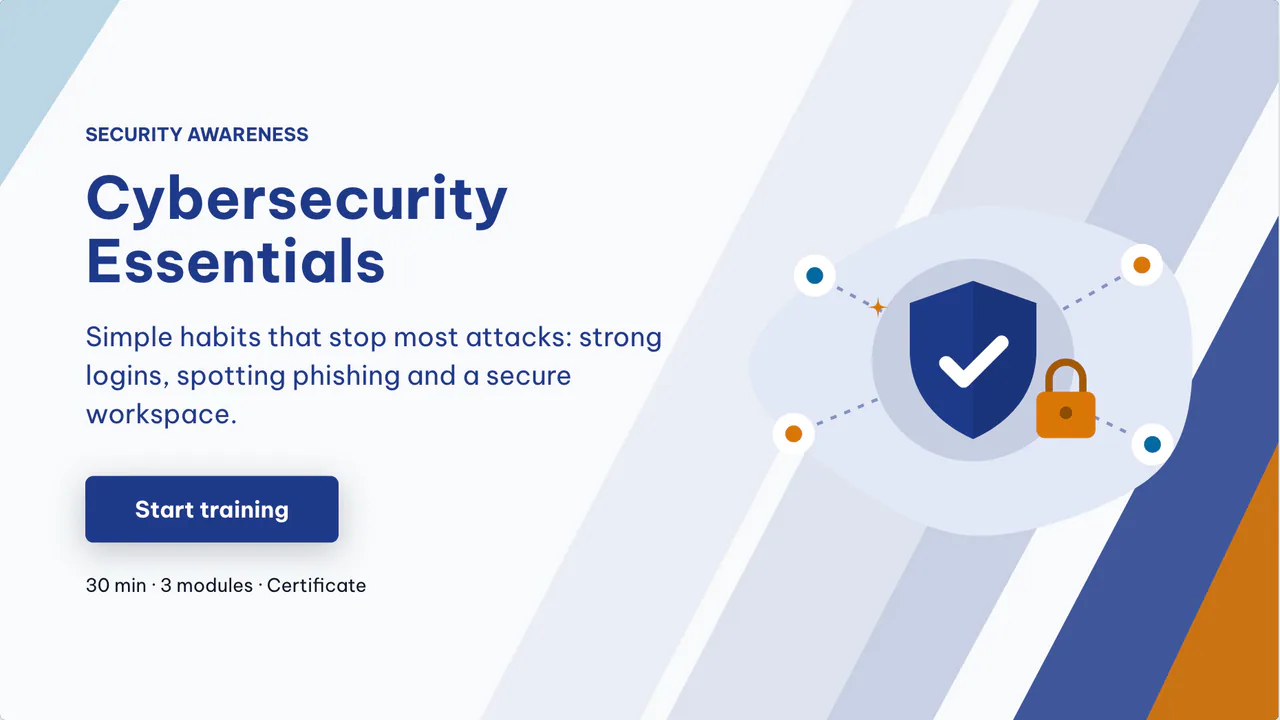
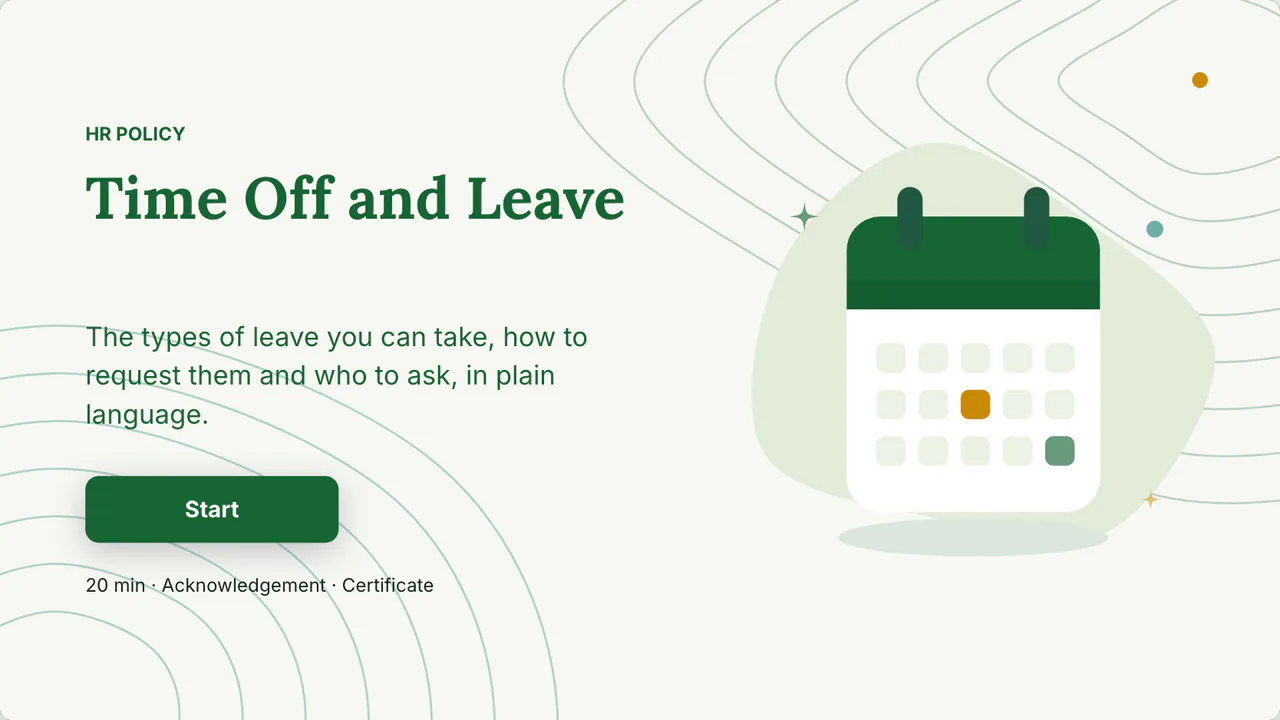
With Lumesson you can start from one of the compliance templates — Code of conduct (with a scenario, a quiz-board game, a 100% pass mark and an acknowledgement), Data privacy & GDPR, Respectful workplace, Cybersecurity awareness, the Phishing Simulation and the leave and expenses HR policy courses. Or choose Compliance & policy when you create a course with Lume AI, add up to six documents — your actual policy, a regulator’s guidance, last year’s deck — and approve the outline before it builds the slides, scenarios and test. Then have your compliance lead review every fact against the source.

Choose “Compliance & policy” and give Lume AI your own policy documents to work from.
A compliance training checklist
- Mandatory topics, audiences and frequencies agreed with Legal or Compliance.
- Three to five real decisions per course, written as behaviours.
- Scenarios for the grey areas; the full policy in resources and the glossary.
- A test from question banks with a passing score that fits the risk.
- An acknowledgement, a certificate and clear completion rules in the LMS.
- Accessibility checked, captions on, phone layouts on.
- A version number, a review date and short refreshers in between.
Want to try it on your own policy? Download Lumesson for Mac and start from a template or a document.